
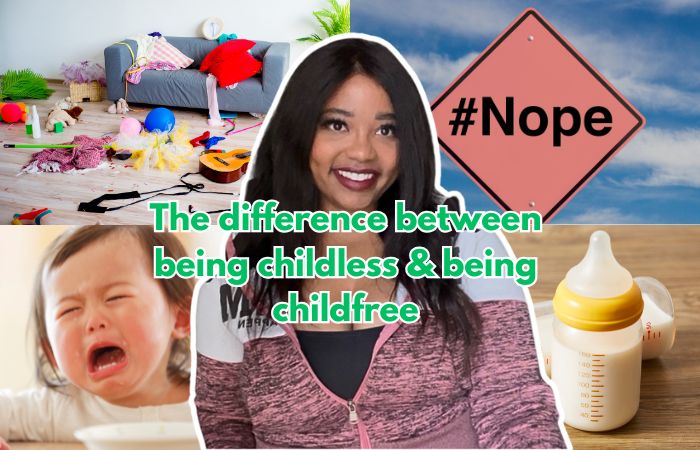
I want to have a conversation about the difference between being childless and being childfree.
These two terms are often used interchangeably, but they are not the same—and the distinction matters.
In the simplest terms, being childless means you want children but don’t have them, whether due to infertility, life circumstances, or the adoption process still being underway. There’s a sense of absence and longing tied to being childless.
Being childfree, on the other hand, means you do not want children. You’ve intentionally chosen a life without them.
The word “free” is key here—it implies freedom from the responsibilities and constraints that parenthood brings.
For childfree women, there is a deep sense of autonomy and fulfillment in not pursuing motherhood.
A Personal Perspective
I recently commented on a TikTok video by a woman celebrating her childfree life.
I’m childfree myself and chimed in with support.
While scrolling through the comments, I noticed some people arguing about the definition of childless versus childfree, and I was honestly surprised.
I hadn’t realized this distinction wasn’t clear to everyone.
People often assume childfree women must hate kids. That’s not true. I can’t wait to become an aunt—I’ll pour as much love as possible into that child.
But I personally don’t want to be a parent. Being childfree means I’ve chosen a life that doesn’t include raising a child. It’s not about dislike—it’s about desire, lifestyle, and intention.
A life of flexibility
At a recent crochet class, a young mom was talking to another woman who had just uprooted her life from the Midwest and moved to Las Vegas.
I resonated with that story because I did the same thing—packed up my car and moved from California to Vegas at 24.
I had no ties, no responsibilities holding me back. That kind of freedom is rare for parents.
The young mom remarked, “I wish I could do something like that, but I can’t because of my kids.”
That hit me. It’s exactly why I choose not to have children—I want the freedom to pivot, to reinvent myself. That’s not a judgment; it’s just my reality.
She also mentioned hating her job but being unable to quit because her children depend on her income.
Meanwhile, I’ve quit multiple jobs without knowing what was next. I’ve worked at Starbucks, Victoria’s Secret, as a cocktail waitress, as a showgirl in Vegas, and for countless publications.
I left any role that didn’t align with me, and I always landed on my feet. That flexibility is a privilege I don’t take for granted.
Stories of freedom
There’s a guy online known as Sailing with Phoenix who left his corporate job of 11 years, cashed out his 401(k), bought a sailboat, and sailed from Oregon to Hawaii.
His story resonates because, like me, he doesn’t have kids.
When another man saw that story and said, “If I didn’t have a wife and kids, I’d do that too,” it struck me.
People without children can live spontaneous, adventurous lives that simply aren’t possible when raising a family.
I’m married, and luckily, my husband shares this passion for freedom.
We can plan a date night or a weekend getaway on a whim. We don’t need to arrange childcare or juggle nap schedules. That’s intentional.
Misconceptions about regret
Some believe childfree people will eventually regret their decision. But I’ve searched endlessly for stories of regret from childfree women—and I haven’t found any.
What I do see are regretful parents, or childless women who wanted children but couldn’t have them.
There are entire forums, like the “Regretful Parents” threads on Reddit, filled with moms and dads grieving the loss of their former selves.
They speak about how hard parenting is, how it changed them, and how they sometimes wish they’d chosen differently.
These aren’t rare accounts—they’re increasingly common and candid, thanks to social media.
We are living in an era of honesty.
TikTok, Reddit, Instagram, and YouTube are filled with people pulling back the curtain on parenthood.
Some warn others not to rush into it.
For the first time, women are waking up to the fact that motherhood is a choice, not a requirement. And for many of us, it’s not the right one.
Societal pressure and rewriting the narrative
From the time we’re young, we’re sold a narrative: grow up, get married, buy a house, have kids.
That story is reinforced by movies, books, and even family traditions. But it’s not the only story.
You do not have to follow the script. You can opt out.
Parenting is arguably the hardest job there is, and I admire those who choose it. I respect it deeply. But that doesn’t mean it’s for everyone, and that’s okay.
What’s not okay is the judgment childfree women face.
I’ve been called a “wasted womb,” as if the only purpose of my existence is reproduction.
That’s an outdated and offensive notion. I have countless dreams and goals that don’t involve motherhood—and that should be enough.
The freedom of intentional childfree living
To live childfree is not to live selfishly—it’s to live intentionally. I didn’t stumble into this lifestyle by accident or luck.
I made a conscious choice. I want a life where I can chase passion, travel spontaneously, rest when I need to, and nurture the relationships that bring me joy.
The world has changed since our parents had kids. T
he economic, environmental, and social outlook for millennials is vastly different from what boomers experienced.
Owning a home, retiring comfortably, affording childcare—these are not givens for us.
And if I don’t feel optimistic about the future for myself, why would I bring a child into that?
Ultimately, being childfree and childless are different AF
The difference between being childless and being childfree is not just semantics—it’s about mindset, desire, and identity.
Childless women long for a child they don’t have.
Childfree women are fulfilled without one.
If you’re solid in your decision to remain childfree, rest easy. You’re not missing out—you’re living on your terms. And contrary to the myths, childfree women don’t look back in regret. They thrive.
We are not wasted wombs. We are women with choices. And that, to me, is the very definition of freedom.


Leave a Reply